Rondawel's history: from a widow's mark to today's Marincowitz farm
The Venter household of 1829, the grant day of 1841, the Oosthuizen-Theron partnership that split in 1872, and a Bothma mother behind the man who owned the other half
From a loan-farm widow who signed with a mark to the Marincowitz farm of today: the full documented history of Rondabel No. 124 - the Venter household of 1829, the twelve-farm grant day of 1841, the Oosthuizen-Theron partnership of 1868, the 1910-34 subdivisions, and the two graves by the huis nobody has read.
A word about how many surnames this page carries. Venter, Strydom, Oosthuizen, Theron, Bothma, du Plessis, Marincowitz. They read like seven families and they are closer to one. The Venters and the Strydoms married Oosthuizens in the same generation; Theron married an Oosthuizen's sister before he took half the farm with her brother; the Marincowitz who farms it now carries Oosthuizen inside his own given names from two successive Oosthuizen mothers. A farm changing hands in this district is usually a farm staying in one connected family, and the deeds cannot show that because a deed records a surname.
The place
Rondabel lies on the Traka. Khoi for "river of women", in the dry country east of the Swartberg, in the old Field Cornetcy of Traka of the Beaufort district, later the Prince Albert division. Its western neighbour is Middelwater No. 169; Kopjes Kraal lies to its east, Rhemhoogte and Klip Gat to the north, and to the south the ground ran out into Government land, the open Koup. The modern cadastral farm 124 measures 13,883 ha.
The name drifts through the records the way all Karoo names do: de Rondabel (1818), Rondabel in Tarka (1823), the place Rondavel (1829), Rondable on the Surveyor-General diagrams, Rondabel in the cadastre, and Rondawel today. That last is the modern Afrikaans spelling and the name the farm goes by now, which is why the title above uses it. The rest of this page uses Rondabel throughout, because it is the form the records carry.
The loan-farm era (before 1841)
The earliest documents are three estate inventories from the Master of the Orphan Chamber. Two are probably another farm's; one is beyond doubt.
The record that is beyond doubt (MOOC8/44.48). Jan Adriaan Venter (b. 1794) died on 23 July 1829. The inventory opens like this, and it is worth having in full rather than clipped, because the whole of its value is in how specifically it places the household:
A true and perfect inventory of all and every the goods, chattels, wares and merchandise as well moveable as not, debts, credits and other personal effects of Maria Catharina Elisabeth Venter and deceased husband Jan Adriaan Venter which latter died at the place Rondavel on the 23:rd July last between the hours of 11 and 12 p:m: within the field cornetcy of Hermanus van der Westhuisen in the Traka district of Beaufort
Farm, ward, region and district all named. This is the earliest household on the Koup Rondabel that can be placed with certainty, four years before the first survey. And it was family ground already: his widow, Maria Catharina Venter, was the elder sister of Adriana Cecilia Venter, wife of Ockert Almero Oosthuizen (1786–1859), whose descendants would take title to this same farm a generation later.
The inventory is a portrait of a young frontier family living thin: one bed, three chairs, four plates, a defect ox wagon, and 707 sheep and goats, their whole wealth on four legs. No cash, no credits, and every debt owed to the widow's own Venter family, who were carrying them. Five children aged two to ten, their birthdates recorded to the day; the second son, Jan Louis, born at Wolve Kraal on his father's own birthday, twenty years before Wolwekraal's 1841 grant to Johannes Hendrik Venter, most probably the widow's brother not yet verified. The widow signed with a mark: she could not write. How the farm passed from her household to the Strydoms by the 1833 survey, a widow with five small children likely could not hold the place, is an open question.
Two earlier records, probably a namesake farm. In 1818 the estate of Ignatius Michael du Plessis was taken on a "leeningsplaats genaamd de Rondabel gelegen aan de Tarca" (MOOC8/64.12a), half the opstal, a widow, Aletta van Heerden, three children under five. In 1823 the estate of Jan de Bruin and his widow Aletta Johanna Oosthuizen listed "1 leeningsplaats Rondabel gelegen in Tarka" first among its goods (MOOC8/38.12). But these two records name no field cornet, no Traka, no Beaufort, and the de Bruin estate sold its sheep to a Grahamstown butcher. The case the other way is real and once closed this question here: Rondabel's own 1833 diagram stands in the Field Cornetcy of Traka, and Traka for Tarca is ordinary spelling drift. It was reopened because proving a Traka in the Koup says nothing about a Tarka in the east. The working position is that the inventories describe an eastern-Cape namesake farm not yet verified. One finding survives either way: the 1823 widow has been identified as Aletta Johanna Susanna Oosthuizen (c. 1775–1834), a second cousin of Ockert Almero Oosthuizen. If her farm resolves east, she loses the farm but stays in the family.
Survey and title (1833–1841)
In August 1833 surveyor Charles Lennox Stretch measured Rondabel for Johannes Strydom: 11,352 morgen, bounded north by Rem Hoogte, south by Witte Water, east by Witte Klip, west by Droege Kloof (SG diagram 366/1833). It was one farm in a two-season campaign. Stretch surveyed Middelwater, Vrolykheid, Klaarstroom and Varsche Fontein in the same seasons, walking each boundary with the occupier and the field cornet.
Then, after seven years in which the paper shows nothing, came 15 April 1841: the Crown converted at least twelve Koup and Gouph loan farms to perpetual quitrent in a single administrative act. Rondabel went to David Jan Strydom ("Daniel son"), folio 989, the full story of that day is told in The fifteenth of April, 1841. The district's map was drawn in two seasons of fieldwork and ratified in an afternoon.
The farm comes to the Oosthuizens (1863–1872)
In November 1863 the farm was resurveyed at 16,151 morgen, some 4,800 morgen more than Stretch's figure, and on 21 January 1868 it was granted anew on perpetual quitrent to Jan Adriaan Oosthuizen and Stephanus Johannes Theron (SG diagram 502/1867). These two were brothers-in-law: Theron had married Jan Adriaan's sister at Prince Albert in 1851, and Jan Adriaan is almost certainly the Johannes Adriaan Oosthuizen born at Graaff-Reinet in 1816, son of the Middelwater household not yet verified.
Theron came from further west than the Koup, and from a family this record meets elsewhere. He was baptised on 6 September 1828, three days old, in the veldcornetcy Klyn Roggeveld, and the register gives his parents as Petrus Jacobus Theron and Aletta Francina Bothma. Two of the four witnesses are Botmas: Stephanus Johannes Botma, whose names the child was given, and Gerrit Botma. [SRC-546] The man who took half of Rondabel in 1868 was a Bothma on his mother's side, and the Bothmas would hold Spreeufontein in the same decade. They came off the same ground. Lodewyk Botma, who held Spreeufontein when the first gold came out of it, was born in the Klein Roggeveld on 24 May 1802, and his mother was born there too and was still in the Middel Roggeveld when she died in 1837. [SRC-601] [SRC-603] So this is one Botma community moving east into the district rather than two families sharing a surname. Which of its men fathered Aletta Francina is still open: she was born on 10 September 1794 and that couple were baptising a daughter of their own twenty days later, so she is not their child. not yet verified The partnership divided on paper on 17 July 1872, when a portion went to Theron alone (diagram 922 of 1872, framed from actual survey on 6 June 1872 and copied from the diagram relating to Transfer 208 of 17 July 1872); every later subdivision descends from that Theron portion.
Sold, not inherited, and the dates say so
The obvious reading of a farm changing hands is that somebody died. Here that reading is wrong, and one date rules it out.
David Jan Strydom died on 11 January 1882, fourteen years after Rondabel left his hands, aged eighty-three. He held the first title from 1841, and he was alive and outlived the 1868 grant by a decade and a half. Whatever moved the farm to Oosthuizen and Theron, it was not his estate.
That narrows it usefully without closing it. The 1868 instrument is not itself a sale: it is a fresh perpetual-quitrent title following the November 1863 resurvey, which found 16,151 morgen where Stretch had measured 11,352. The Crown was re-titling a re-measured farm, and the men named on the new title are the men who held it by then. So the actual change of hands sits somewhere in the twenty-seven years between 1841 and 1868, and the deed that carried it is not held here. What can be said is what it was not: not an inheritance from the first titleholder.
The manner of the acquisition is legible even where the deed is not. Two brothers-in-law took it together. Theron had married Jan Adriaan's sister Dina Magdalena Oosthuizen at Prince Albert on 27 January 1851, seventeen years before the two men appear on one title. This is how ground moved in this district: not a purchase by a stranger with capital, but two households pooling what they had, with a marriage already holding them together. And it did not hold. On 17 July 1872 the partnership divided, Theron taking a portion in his own name, and every later subdivision of Rondabel descends from that split.
What their lives looked like in 1868
They were not young men taking a first farm. At the January grant Johannes Adriaan Oosthuizen was fifty-one, Theron thirty-nine, and Dina Magdalena thirty-five, seventeen years married. Strydom, letting it go, was sixty-nine.
Nor were they strangers to him. Strydom's sister Anna Magdalena, baptised at Paarl in November 1790, had married Jacobus Johannes Oosthuizen at Uitenhage on 6 March 1808 and gone to live on the Olifants; her husband was the elder brother of Ockert Almero of Middelwater, and Ockert Almero was Johannes Adriaan's father. So the man taking the farm was the nephew of the man who had married the seller's sister. The two families had been joined for sixty years by the time the title moved, which is not the deed this history is missing but it is the reason the deed would have been easy to draw.
And they were buying into the best years the Karoo would have. The decade around that title is the district at its most prosperous, and the record here shows it from several directions at once:
- Wool was the money. In June 1870 a million kilograms of wool went out through the poort in a single season. Sheep on this veld were paying for land.
- Ostriches were arriving. Wire fencing and lucerne had made feathers farmable, and the first feather boom was building through the 1860s.
- The mineral revolution had just begun somewhere else. Diamonds were found at Kimberley
in 1867, the year before the grant, and in August 1871 an aardvark turned up the first gold nugget on Spreeuwfontein, forty kilometres away.
- The colony was changing shape. Responsible government came to the Cape in 1872, and the railway reached Beaufort West in 1880.
So 1868 sits at a hinge. These two men took a re-measured 16,000-morgen quitrent farm in the last decade in which the Karoo's wealth still came entirely off its own back, wool, and then feathers, and before rails, mines and a world depression rearranged what a farm was worth. The Long Depression began in 1873, five years after they signed.
Neither of them saw much of what followed. Theron died at Willowmore on 7 January 1879, aged fifty, out of the district and eleven years after taking the farm; his estate's disposal is the deed this history is still missing. Strydom died on 11 January 1882 and Oosthuizen on 11 August 1882: the man who let the farm go and the man who took it, seven months apart. Dina Magdalena outlived her husband by twenty-nine years, to 1908.
The family did not leave the farm. On 10 April 1895 Cecilia Maria Theron, born du Plessis, died on it of consumption, after five months' illness, aged thirty-eight. Her death notice (MOOC 6/9/340) gives her usual place of residence as "Rondavel, Klaarstroom, Ward Kredouw", the place she died as the same, and her place of burial as "on farm Rondavel". The informant was her husband Petrus Jacobus Theron, Stephanus Johannes's son, then forty-one and living on the ground his father had been granted twenty-seven years earlier. Dr Stevenson came out from Prince Albert to attend her. She left nine living children, the eldest seventeen and the youngest two, and the form records two more who had died as infants.
That one sheet carries two things the rest of this history wants. The Therons were still on Rondabel sixteen years after Stephanus Johannes died at Willowmore, which is the stretch with the least paper in it. And the farm was already Rondavel to the people living on it: her husband wrote the word three times in one form in 1895, the name the cadastre would fix much later on one portion while the parent farm kept Rondabel.
The English slept under the thorn tree, 1901
The war reached this werf, and the only record of it is a son remembering his father.
Helena Marincowitz interviewed Tokkie Marincowitz for her 1999 history of the district, and placed him the way she placed all her informants, by his ground: formerly farmed on Rondawel, now living in Oudtshoorn. [SRC-172] What he told her was this:
A group of English slept one night under the thorn tree near the 'Rondawel' farmhouse. My father (Oosthuizen Marincowitz) picked up Lee-Metford cartridge cases there. They also visited the neighbouring farm Koppieskraal (not where Scheepers was captured) and asked for food.
That puts Gert Jan Oosthuizen Marincowitz on this werf in 1901, and it matters because the deeds do not. This farm's Marincowitz chain begins on paper in 1934, and Tokkie's own title runs from 1954. A boy's father picking spent cartridge cases off the ground by the farmhouse is not a deed and it is not nothing: it is the family here, on this ground, half a century before the first document that says so. not yet verified against the deeds chain before it is read as a holding.
The date is almost certainly February 1901. Scheepers's commando took Klaarstroom on the first and the running fight down the Prince Albert road happened the next day, seventeen kilometres from here. Marincowitz does not date the night under the tree and neither does this page.
(A second account in the same book puts a man of that name somewhere else. Almero Oosthuizen, interviewed at p.38, has "two bachelor brothers, Boy and Oosthuizen Marincowitz" farming at Koppieskraal, the neighbour Tokkie names. Gert Jan married and had children, so bachelor does not fit him unless it describes an earlier stretch of his life. Whether that is one man on two farms or two men sharing a name is LEAD-0344.)
Subdivision (1910–1934)
The Theron portion broke up across a quarter-century, and the buyers tell the district's story in miniature:
| Date | Portion | Name | Extent | To |
|---|---|---|---|---|
| 26 Nov 1910 | Ptn 3 | Brand Kraal | 4 mg | (diagram 1654/1910), a tiny water or building site |
| 10 Jun 1919 | Ptn 5 | Hartebeest Voedpad | 1,606 mg | Almero Jacobus Hitge Oosthuizen |
| 8 Jul 1921 | Ptn 6 | Elandsfontein | 2,705 mg | "A. Oosthuizen", almost certainly the same Almero not yet verified |
| 16 May 1934 | Ptn 7 | Klein Elandsfontein | 1,544 mg | Gerolm Samuel Marincowitz |
Almero Jacobus Hitge Oosthuizen (1878–1961), the fourteen-year-old who drove the schoolteachers over the Swartberg Pass in 1892, bought 4,311 morgen of Rondabel ground in 1919–21, a great-grandson of the Middelwater generation buying back onto the farm his forebear had been granted in 1868. Gerolm Samuel Marincowitz (1870–1941), son of Nicholas James Marincowitz and Catharina Maria Oosthuizen, brought the Marincowitz name onto the farm in 1934, already carrying Oosthuizen blood.
The surveys left their own record of the ground. J.A. Loubser's 1919 beacon report found cairns four feet high, three beacons missing, a stone wall that agreed with the diagram angle, and recorded his "very grave doubt as to the accuracy of Surveyor Luttig's distance". His field sketch names the beacons like a poem of the veld: Klip, Camp, Honing Nest Poortje, Meerkat, Fontein, Gravel Krantz, Hartebeest, Skeur, Witbaken, Predikant Rand.
The Marincowitz farm
The farm settled into the Marincowitz family in three movements. They surrounded it. Kopjes Kraal and Oude Muure, on Rondabel's east, are Marincowitz farms. They married in, from Nicolaas James Marincowitz's 1866 marriage to an Oosthuizen, the two families intermarried in every generation. They bought in. Klein Elandsfontein in 1934 is the first documented purchase; the deed that carried the Remainder into Marincowitz hands is still missing from the record not yet verified.
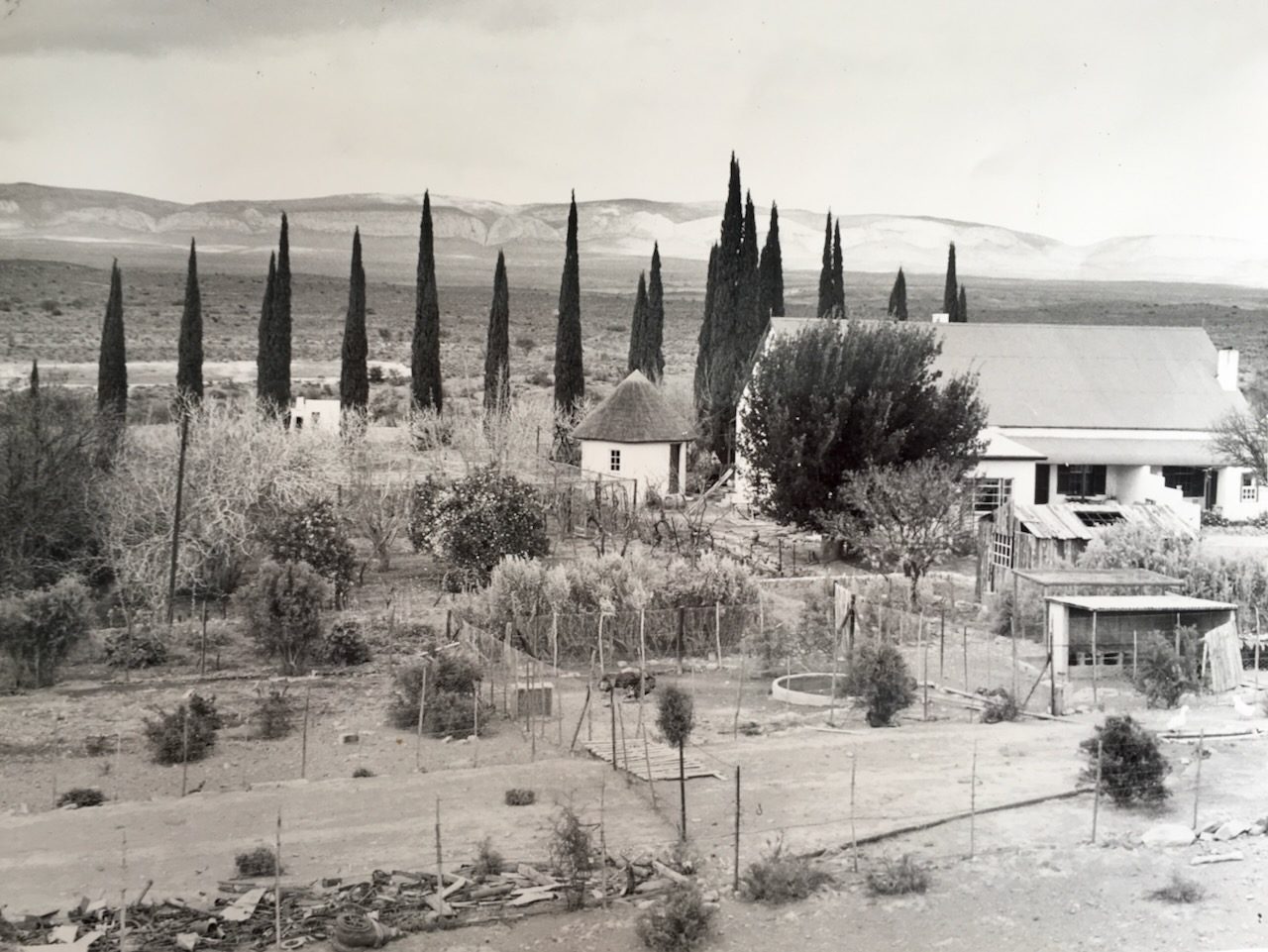
Gert Annis Oosthuizen Marincowitz, "Tokkie" (1919–2003), farmed Rondabel until his death. His middle names were earned twice over: his grandfather married Catharina Maria Oosthuizen in 1866, planting the surname inside Gert Jan Oosthuizen Marincowitz (1875–1952); Gert Jan then married Anna Margaretha Oosthuizen in 1918, so Tokkie carried the name from two successive Oosthuizen mothers. Graves lie close to the farmhouse, remembered from family holidays on the farm, and one of them is now named. Cecilia Maria Theron's headstone was photographed there in 2006, weathered and cracked across the foot but still legible: Geboren du P[lessis], den 9 January, and the year she died. [SRC-541] So the woman who died of consumption in the house in 1895 lies a short walk from it. How many graves stand with hers is less certain than it sounds: two were remembered, and then a recollection of her stone standing a few metres from a pair, which would make three. None of the others has been read. The farm remains with the Marincowitz family today.
The chain of ownership
| Period | Holder | How |
|---|---|---|
| by 1818 / by 1822 | (probably a namesake farm) du Plessis · de Bruin | Loan-farm inventories "in Tarka", under investigation |
| by 1829 | Jan Adriaan Venter & Maria Catharina Venter | The first beyond-doubt household; he died on the farm |
| 1829–1833 | Venter widow → the Strydoms | Not recorded |
| 15 Apr 1841 | David Jan Strydom | First title, perpetual quitrent, folio 989 |
| 1841–1868 | Strydom → Oosthuizen & Theron | Not an inheritance, Strydom lived to 1882. The deed that moved it is missing |
| 21 Jan 1868 | Jan Adriaan Oosthuizen + S.J. Theron | Granted anew, title P.A.Q.1-21 |
| 17 Jul 1872 | Split: Theron takes a portion | Every later subdivision descends from it |
| 7 Jan 1879 | Theron dies at Willowmore, aged 50 | ⟨ break ⟩, his estate's disposal is the missing deed |
| 1910–1934 | Portions sold | To Oosthuizen (1919, 1921) and Marincowitz (1934) buyers |
| by mid-1900s | The Marincowitz family | ⟨ break ⟩, the Remainder's deed not yet found |
| to 2003 | Tokkie Marincowitz | Farmed it until his death |
| today | The Marincowitz family | Prince Albert valuation roll |
What this story is about
- set on Rondabel
- set on Brand Kraal (Rondabel No. 124 Ptn 3)
- set on Hartebeest Voedpad (Rondabel No. 124 Ptn 5)
- set on Elandsfontein (Rondabel No. 124 Ptn 6)
- set on Klein Elandsfontein (Rondabel No. 124 Ptn 7)
- about Jan Adriaan Venter
- about Maria Catharina Venter
- about Jan Adriaan Oosthuizen
- about Stephanus Johannes Theron
- about David Jan Strydom (Daniel son)
- about Almero Jacobus Hitge Oosthuizen
- about Gerolm Samuel Marincowitz
- about Gert Annis Oosthuizen Marincowitz
Sources
Everything this story rests on, with a link to the original wherever one exists. Where a citation is incomplete it says so, an incomplete citation is a research gap, not a formatting problem. If your work is here and the credit is wrong or thin, please tell us and it will be fixed.
- Surveyor-General diagram, 366/1833, August 1833 Surveyor-GeneralSG Dgm 366/1833
- Surveyor-General diagram, 502/1867, November 1863 Surveyor-GeneralSG Dgm 502/1867
- Diagram verso, 502/1867 (verso) Surveyor-GeneralSG Dgm 502/1867 (verso)
- Surveyor-General diagram, 922/1872, 6 June 1872 Landmeter-Generaal, KaapstadNo. 922/1872 (written over a struck 161/1872); framed from actual survey 6 June 1872 by J.W. du T. Melvill, Govt. Surveyor; examiner L. Marquard; deducted 29 June 1872, Fred Ruysch, Govt. Sur.; copied from the diagram relating to Transfer Deed No. 208 dated 17.7.1872; Sheet BL-2
- Estate inventory, deed MOOC8/38.12, 13 June 1823 Cape Town Archives RepositoryMOOC8/38.12
- Estate inventory, deed MOOC8/64.12a, 2 May 1818 Cape Town Archives RepositoryMOOC8/64.12a
- Surveyor-General diagram, 1654/1910, August 1910 Surveyor-GeneralSG Dgm 1654/1910
- beacon_report, 1654/1910, 16 September 1910 Surveyor-General1654/1910
- Surveyor-General diagram, 270/1919, January 1919 Surveyor-GeneralSG Dgm 270/1919
- Surveyor-General diagram, 1872-23-208, 1919 Surveyor-General1872-23-208
- Surveyor-General diagram, 1919 Surveyor-General
- Surveyor-General diagram, 891/1921, 1921 Surveyor-GeneralSG Dgm 891/1921
- beacon_report, 891/1921, 10 March 1921 Surveyor-General891/1921
- Surveyor-General diagram, 3273/1933, January 1919 Surveyor-GeneralSG Dgm 3273/1933
- Estate inventory, deed MOOC8/44.48, 29 October 1829 Cape Town Archives Repository (KAB), Master of the Orphan Chamber; TANAP transcription (within corpus SRC-128)MOOC8/44.48
- Rondabel No.124 original grant diagram (1833) Surveyor-GeneralSG Dgm 366/1833
- Rondabel No.124 diagram 502/1867 Surveyor-GeneralSG Dgm 502/1867
- Rondabel No.124 - reverse: deduction table Surveyor-GeneralSG Dgm 502/1867 (verso)
- SG Dgm 922/1872 - Portion 1 of the farm Rondable No. 124, Prince Albert Landmeter-Generaal, KaapstadNo. 922/1872 (written over a struck 161/1872); framed from actual survey 6 June 1872 by J.W. du T. Melvill, Govt. Surveyor; examiner L. Marquard; deducted 29 June 1872, Fred Ruysch, Govt. Sur.; copied from the diagram relating to Transfer Deed No. 208 dated 17.7.1872; Sheet BL-2
- MOOC8/38.12 - Jan de Bruin & Aletta Johanna Oosthuizen, 13 Jun 1823 Cape Town Archives RepositoryMOOC8/38.12
- MOOC8/64.12a - Ignatius Michael du Plessis & Aletta Elisabeth Dorothea van Heerden, 2 May 1818 Cape Town Archives RepositoryMOOC8/64.12a
- Rondabel Portion 3 "Brand Kraal" diagram Surveyor-GeneralSG Dgm 1654/1910
- Rondabel Portion 5 "Hartebeest Voedpad" diagram Surveyor-GeneralSG Dgm 270/1919
- Rondabel Portion 6 "Elandsfontein" diagram Surveyor-GeneralSG Dgm 891/1921
- Rondabel Portion 7 "Klein Elandsfontein" diagram Surveyor-GeneralSG Dgm 3273/1933
- MOOC8/44.48 - Inventory, estate of Jan Adriaan Venter & Maria Catharina Elisabeth Venter, taken at the place Rondavel, Traka, district of Beaufort, 29 Oct 1829 Cape Town Archives Repository (KAB), Master of the Orphan Chamber; TANAP transcription (within corpus SRC-128)MOOC8/44.48
- Death notice, 10 April 1895 KAB (Western Cape Archives and Records Service), Master of the Orphan Chamber / High Court (MOOC), death notices series 6/9DEPOT KAB, SOURCE MOOC, VOLUME_NO 6/9/340, REFERENCE 1007. BEGIN DATE 1895, END DATE 1895.view it online →
- Baptism register 1828, pages 106-107: Stephanus Johannes Theron, born 3 September 1828, veldcornetcy KLEIN ROGGEVELD Dutch Reformed Church register, supplied via FamilySearch; image numbered 345Opening headed 1828, left leaf p.106, right leaf p.107. The entry is the second on the right leaf, dated 6 September.
- Headstone of Cecilia Maria Theron, born du Plessis, died April 1895 - photographed at Rondabel Family photograph, supplied by Frans OosthuizenPrint with an in-camera date stamp of 29/4/2006; photographed from the print, 22 Aug 2026
Photographs
Research notes
Compiled 30 Jul 2026 from the land model. Inline entity markup (person:/farm:/doc:/event: URI schemes) for the site build - see SITE-TASK-rondabel-story.md.
[5 Aug 2026, moved out of the prose] . The 'PS, 31 July 2026' section is gone; its two findings - the 1867 batch resurvey, and the probable mistranscription of Rondabel's 1841 folio - are now body sections. The removed framing said the Klipfontein diagram 'arrived on 31 July'.
[12 Aug 2026] BOLD PASS, both languages. 0 and said it still had lots of bold words and phrases, on a file the voice check had scored 0/3/0 and closed. Rule 4 counts bold carrying a whole SENTENCE and is blind to bolded PHRASES, so a speckled page reads as clean. checks.py now measures DENSITY - bolded words as a share of the page - against the S035 benchmark's 1.1%, plus an en/af asymmetry check, and this story was on that list. Out: dates, extents, survey records, deed and folio numbers, place names and, in S005, whole bolded sentences. STORY-VOICE.md names those exactly, and the benchmark bolds NOTHING in its narrative. NO WORD, FACT, HEDGE, [TO VERIFY], CITATION OR LINK CHANGED - the edit removed emphasis markers. verify_af passing.
[13 Aug 2026] VOICE PASS. af 1/0/0 -> 0/0/0, and the English had the same fault unreported. 'the deed that carried it is not in this record' / 'is nie in hierdie rekord nie' -> 'is not held here' / 'is nie hier nie'. What the sentence is doing is unchanged: the change of hands sits somewhere in the twenty-seven years between 1841 and 1868, the deed is missing, and what CAN be said is what it was not - not an inheritance from the first titleholder.
[15 Aug 2026] CHECKED AGAINST THE RECORDS IT LINKS TO, with the early section and the sources read hardest. ONE ERROR FOUND, and it was a link rather than a claim: the sentence about 'the second son, Jan Louis, born at Wolve Kraal on his father's own birthday' pointed at PER-000096, who is Jan ADRIAAN Venter, born 8 December 1823. The father was born 14 September 1794 and the transcription of MOOC8/44.48 records heir #2 as JAN LOUIS Venter, born 14 September 1821 at Wolve Kraal, against tree id - which PER-000523 carries. The prose was right about the man, the date, the farm and the coincidence of birthdays; only the row it pointed at was wrong, and the story's own arithmetic proves it - 'twenty years before Wolwekraal's 1841 grant' works from 1821 and not from 1823. Corrected in both languages.
EVERYTHING ELSE HELD. All 39 person links resolve and match their labels, no farm, document or event link dangles, and all 11 sources carry a title, a repository and a reference. The 1829 inventory checks item by item - 707 sheep and goats, one bed recorded as the only bed in the house, three chairs, four plates - and its place string matches the block quotation word for word. Stretch's 11,352 morgen, all four of his boundaries, the folio 989 grant to David Jan StrydomM 'Daniel Son', the 16,151-morgen resurvey, the Theron marriage of 27 January 1851 and the 13,883 ha modern figure all match their rows. 'Three children under five' on the 1818 du Plessis estate is exact: the transcription gives them as 4, 2, and 10 months. 'At least twelve' farms titled on 15 April 1841 is sound - this model now holds fourteen.
ONE CLAIM I NEARLY 'CORRECTED' AND SHOULD NOT HAVE: David Jan StrydomM, born 12 August 1798 and dead on 11 January 1882, is EIGHTY-THREE and not eighty-four. Subtracting the years gives 84; he died five months before his birthday. The page was right. 9a already carries one instance of correcting a page that had been right, and this would have been the second.
[17 Aug 2026] MINOR, v1.4, both languages: the STORY-VOICE.md pass of 17 Aug - the caveat lead moved or removed where it was housekeeping, and citations rewritten so the source is a noun in the sentence rather than a bracket after the full stop. NO fact, hedge, number, quotation or [TO VERIFY] changed anywhere; verify_af passing.
A LIMIT WORTH RECORDING: the worklist was built from the ENGLISH files, so the Afrikaans was corrected only where the same passage happened to be edited. The Afrikaans side still has its own unattributed tags and needs the same pass. verify_af CANNOT catch this - it compares facts, hedges, numbers and ids, and attribution STYLE is none of those.
[22 Aug 2026, v1.5] A NAMED GRAVE ON THE FARM, AND EVIDENCE FOR THE THIN STRETCH. Cecilia Maria Theron, born du Plessis, died of consumption at Rondavel on 10 April 1895 aged 38 and was buried on the farm; her death notice (DOC-0333, KAB MOOC 6/9/340 ref 1007) is now held. Two things it gives this history: the Therons were STILL ON THE FARM sixteen years after Stephanus Johannes died at Willowmore, which is the period with the least paper; and the household was already writing RONDAVEL in 1895, three times in one form, which is the name the cadastre later fixed on Portion 1 while the parent farm kept Rondabel.
The werf-graves sentence changed: two remain unread, a third now has a name, and whether hers is one of the two is explicitly left open rather than assumed. The Afrikaans summary changed with it.
The open questions are unchanged - who lies in the two graves, and the 1868 deed, are both still open.
[22 Aug 2026, v1.6] FRANS IDENTIFIED THE GRAVE: 'This one is one of the 2 i remember.' So the stone is not a third grave on the farm, it is one of the two by the house, and the prose says so. v1.5 had hedged - correctly at the time, because the photograph carried no location - and the hedge is now wrong. The row GRV-1457 was absorbed into GRV-0021 and retired. Half of LEAD-0011 closes; the second grave is still unread and the story still says so.
[v1.7] THE COUNT OF WERF GRAVES IS NOT SETTLED AND THE STORY NOW SAYS SO. Family memory gave two graves, then this headstone as one of the two, then the stone standing a few metres from a PAIR - which would make three. The prose stopped asserting a number: what is documented is that she was buried on the farm (DOC-0333); what is remembered is the arrangement, and it has moved twice under questioning. Three grave rows are held so the larger count is not silently dropped, and GRV-1458 is marked as the one to retire if a visit finds two.
[v1.8] THE 1868 TRANSFER IS BETWEEN FAMILIES ALREADY JOINED, AND THE STORY NOW SAYS SO. Strydom's sister Anna Magdalena married Jacobus Johannes OosthuizenL at Uitenhage on 6 March 1808 (SRC-544); her husband was the elder brother of Ockert Almero of Middelwater, and Ockert Almero was Johannes Adriaan's father. So the man who took Rondabel in 1868 was the nephew of the man who married the seller's sister. Her baptism record (SRC-543) supplies the parents that prove the sibling link, and an exact birth date of 12 January 1790.
This does NOT supply the missing 1841-1868 deed and the prose says as much - it explains the relationship, not the conveyance, and the chain-of-ownership table is unchanged.
[27 Aug 2026] AFRIKAANS LANGUAGE PASS, v1.9: long sentences broken, tone particles and the gedagtestreep out of our own prose. NOT a content change; verify_af confirms every fact of the English twin survives and the English is untouched.
*** [27 Aug 2026] RESEARCH SWEEP, v2.0. *** THE CO-GRANTEE HAD NO ORIGIN ON THIS PAGE. His baptism turned up on 23 August: Stephanus Johannes TheronL, three days old, 6 September 1828, veldcornetcy KLYN ROGGEVELD, son of Petrus Jacobus TheronL and ALETTA FRANCINA BOTHMA, with STEPHANUS JOHANNES BOTMA and GERRIT BOTMA among the four witnesses (SRC-546). The man who took half of Rondabel in 1868 was a Bothma on his mother's side, and the Bothmas held Spreeufontein in the same decade, which ties two farm histories that had no link between them. Cecilia Maria Theron's headstone is now cited (SRC-541) where the page had described it without a source.
v+ 28 Aug 2026: answers the question the page raised. The Spreeufontein Botmas were born in the same Klein Roggeveld as the Botmas at Theron's 1828 font, so it is one community (SRC-601, SRC-603). Also records that Aletta Francina is NOT a daughter of Stephanus BotmaM and Huibrecht CloeteM: a twenty-day clash with their own daughter's baptism rules it out. *** [7 Sep 2026] v3.0, both languages. *** NEW SECTION: the English slept under the thorn tree by the Rondawel farmhouse in 1901 and Tokkie's father picked up Lee-Metford cartridge cases there. That puts Gert Jan Oosthuizen MarincowitzL on this werf half a century before the 1934 deed the Marincowitz chain begins with. The Koppieskraal tension is flagged, LEAD-0344.
The research behind this page, kept separate from it: dated working notes, open questions, and what is not yet settled.