Two Malherbe brothers write to their sister before going to war, 5 October 1899
On 5 October 1899 two Malherbe brothers write separately to the same sister, six days before the war begins. Jan is killed at Spioenkop, Izak at Pietersheuwel five weeks later, and their sister is the reason both letters still exist
On the evening of 5 October 1899, in Pretoria, two Malherbe brothers wrote separately to the same sister, six days before the war began. Both letters survive. Jan was killed at Spioenkop on 24 January 1900 and Izak at Pietersheuwel on 27 February. Their youngest brother Pieter wrote the day down thirty-seven years later, to argue with a book. Their sister Johanna had come home from the Huguenot Seminary with a teaching testimonial four years earlier, and she is the reason the papers are here.
On the evening of 5 October 1899, in Pretoria, two brothers sat down separately and wrote to the same sister. Both letters survive. Both men were dead within five months.
They were sons of Hendrik Lodewyk Malherbe of Tulbagh, and they had gone north like a great many Cape men before them, to the offices and the mines of a republic that was not the colony they were born in. There were four brothers. Isaak Johannes, called Izak at home and Boetie by the others, was the eldest and lived in Johannesburg. Johannes Barnard, Jan, lived in Kerkstraat, Pretoria. So did Hendrik Lodewyk, Hennie. The youngest, Petrus Jacobus, Pieter, was a young attorney at Boksburg and a partner of General Beyers.
Six days after they wrote, the war began.
What Jan wrote
He begins by explaining why he is writing to a sister and not to his parents.
I feel aardig to write to father and mother. I have to say that Boeti and myself go to the front tomorrow (we have been putting our affairs in order all the evening) and they will feel it so very much.
Then the practical arrangements of a man leaving a household. Boetie has brought his family over, they have laid in six months' provisions, and the two wives must try to get along together. Hennie left on Saturday. Piet was to have gone that day. They would all meet at Volksrust.
He expected a short war, and was wrong about it in the way almost everyone was wrong about it:
I don't think the war will last 6 months, because the Colony will soon be involved, and the European Powers are bound to intervene. If they don't, we shall at any rate give a good account of ourselves and we stand a better chance of winning than of losing.
Then the letter turns, and stops being about the war.
My wife keeps up bravely and only seldom breaks down, while my two little children are innocently jolly; it will be a terrible wrench to part from them all.
I have made provision that in case I don't come back your £50 will be handed to you. Further I enclose a money order for £5 for you sussies to buy a remembrancer in case I fall. Thanks so very much to you all for what you did for me in my youth - mother especially for seeing that we were well schooled. For all the pain I caused her I grieve, and crave forgiveness.
His youngest had been christened Julie the Sunday before. He had wanted to give her his mother's name and his wife would not have it, because a child had already died with that name; mother will not take it amiss. He signs off:
Goodbye my sweet sisters all and father & mother don't weep about us now - we are quite sanguine of seeing you all again, and at no distant date.
What Izak wrote
Shorter, and in two languages, the way people actually wrote:
Dis waar 'n mens het so baja om jou oor te bekommer dat jy nie jou gedagte kan bepaal by een saak kan bepaal.
He is impatient rather than frightened. He does not want to be sent to the border to lie there doing nothing; if it has come to this he would rather see it finished. He has sent money for the children's board and lodging because he will not be able to send any from the field. And then, in one sentence, in the middle of a paragraph about rumours:
Nou ja, should I be killed you must look well after Issie & Annie because I don't want Nellie to be bothered with the children.
Goodbye give my love to all at home.
The dates their mother wrote down
At the foot of Jan's letter, in blue ink, in a hand from much later, somebody has copied out two lines from a birthday book:
In mammie se verjaarsdagboekie is die volgende datums gemerk: Jan. 24, 1900. Jan killed at Tugela. Feb. 27, 1900. Boetie killed.
Both dates are in the register, to the day. Jan was killed at Spioenkop on 24 January 1900, thirty-seven days after the letter reached Tulbagh, and Izak at Pietersheuwel on 27 February, five weeks after his brother. A birthday book is where a family keeps the dates it means to remember, and their mother kept these two in it.
Pieter, thirty-seven years later
In January 1937 the youngest brother, by then sixty-five and living at Plumstead, read a book called Slechtkamp van Spioenkop and sat down to argue with it. The letter runs to two typed sheets and begins with a warning written across the top by hand: Moenie skrik vir die lang brief nie !!!
Most of it is correction. The Boer force at Spioenkop was not three hundred Vryheid men, he says, but nearly a thousand; his own Pretoria contingent came up from the Ladysmith siege and reached the Tugela the night before. He remembers the order arriving:
die Engelse is op Spioenkop en julle moet hulle gaan afhaal!
He remembers the climb, and what a climb it was, and a whole day's fighting. He remembers that when 170 British soldiers stood up with their hands up, the Boers stood up too, and he expected them to be shot down by men who had not surrendered:
so I stoof up, shouted and signalled with my hands to the boers to keep down, which they did - evidently taking me for an officer. I then went forward, conducted the 170 prisoners back behind our front line.
He is careful, immediately, not to let that sound like anything:
It was not the only time either that I acted the part of an officer that day!!! and Heaven knows I am not agressive or disposed to be heroic - one gets callous and do things mechanically.
Then, without raising his voice, he writes the two sentences the whole letter is carrying. The first is what he did at the end of that day:
towards evening helped to carry Jan's body down; then into the saddle again and riding throughout the night and next day escorting the prisoners to Elandsfontein Station. That night at Elandsfontein Station I was so deadbeat that I fell asleep while sitting at an improvised table at supper!
The second is what he did at the bottom of the mountain:
One grew callous, one's senses got hardened. I remember after the fight when I got to the foot of the mountain I started on the bread in my saddlebags with my hands covered with Jan's blood.
He also remembers, going up, passing a dying man with a boy of about fourteen stooping over him and crying aloud, probably his son, and not knowing why the youngster had been allowed in the line at all. On the second sheet, in the new year, at a desk, he writes:
Now that in normal conditions I write this down it almost brings tears into my eyes, but I have no recollection of being unduly affected at the time. I was no volunteer; we had our orders from superior officers.
Then he apologises for the length, says it is too hot to work in the garden, promises to send the interest next week, and signs Pieter. He died eighteen months later.
What the newspaper adds
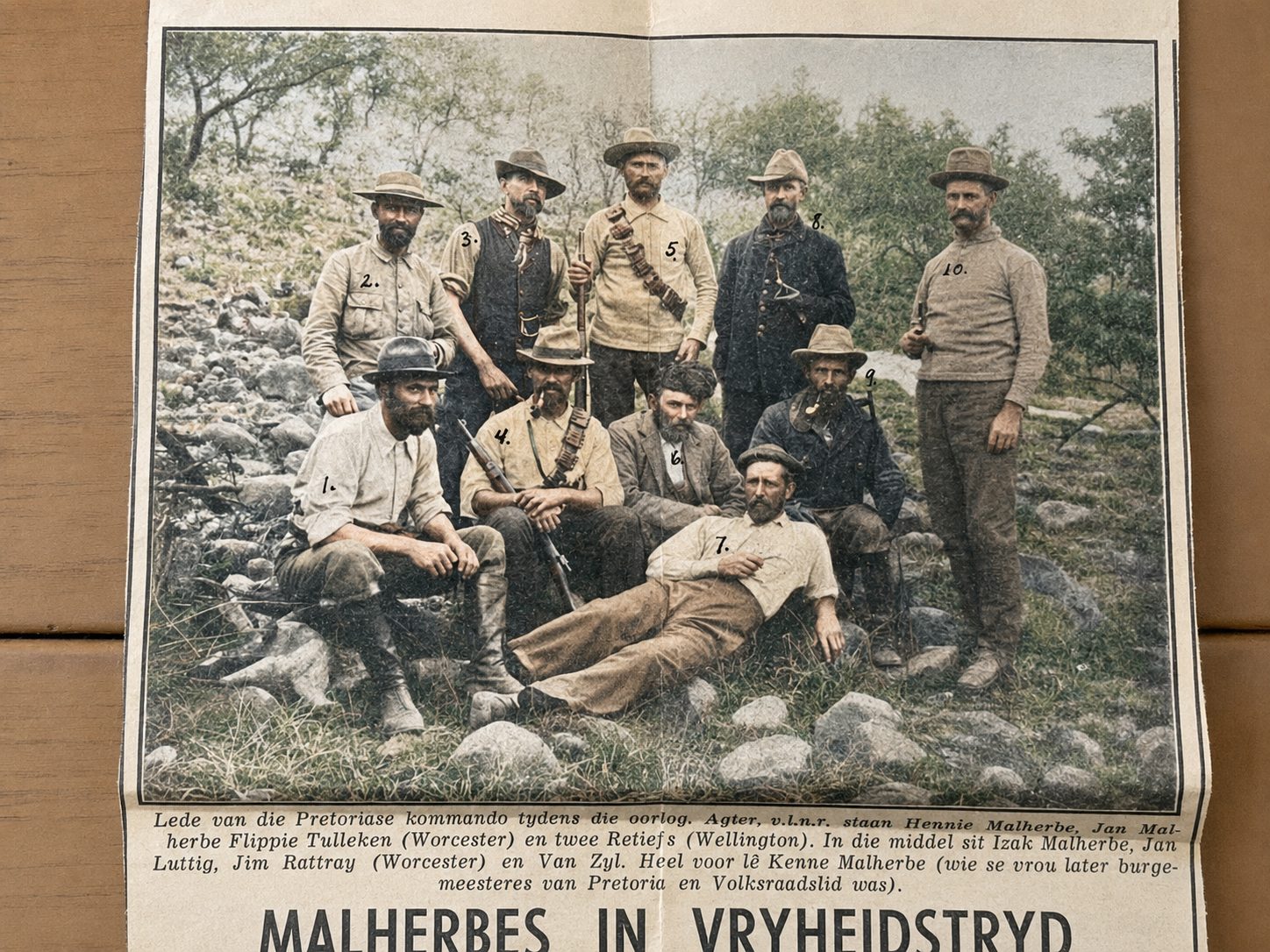
A cutting kept with the letters, Malherbes in Vryheidstryd [SRC-447], was written by dr. W. A. Malherbe, who names himself in the last line as the youngest son of Izak. It puts the four brothers in a unit: between ten and fifteen Pretorians known on the battlefield as die korporaalskap van Izak Malherbe, because the eldest brother was the man the others would follow. When volunteers were called for, Izak would stand up and say Kêrels, ek is gereed om te gaan, and his men stood up with him. One of them was Deneys Reitz, who wrote about Izak with high praise in Commando.
It fills in what the letters could not. Izak brought Jan's body back to Pretoria, where he lies near the heldeakker in the Ou Kerkhof. Izak then went to Johannesburg to greet his wife and his two sons of thirteen and fourteen, went straight back to Natal, and was killed a month later; his grave is in the trenches of Pietersheuwel. Hennie and Pieter finished the war as prisoners at Groenpunt outside Cape Town.
The photograph with it shows ten men of the commando on a hillside, numbered like a school group. Three of the brothers are named in the caption.
Their sister
The letters are addressed to Sus Mimm and to Minni, and the 1937 one to Bettie. There were sisters at home through all of it, and one of them is why the papers came south.
Johanna Fredricka Malherbe was born at Tulbagh on 31 May 1875 and was twenty-four in the October her brothers rode out. Four years earlier she had come home from the Huguenot Seminary at Wellington with a testimonial in her hand, signed by the principal Abbie Park Ferguson in March 1896, certifying two years there and recommending her heartily as a teacher, believing that she will be successful in her work.
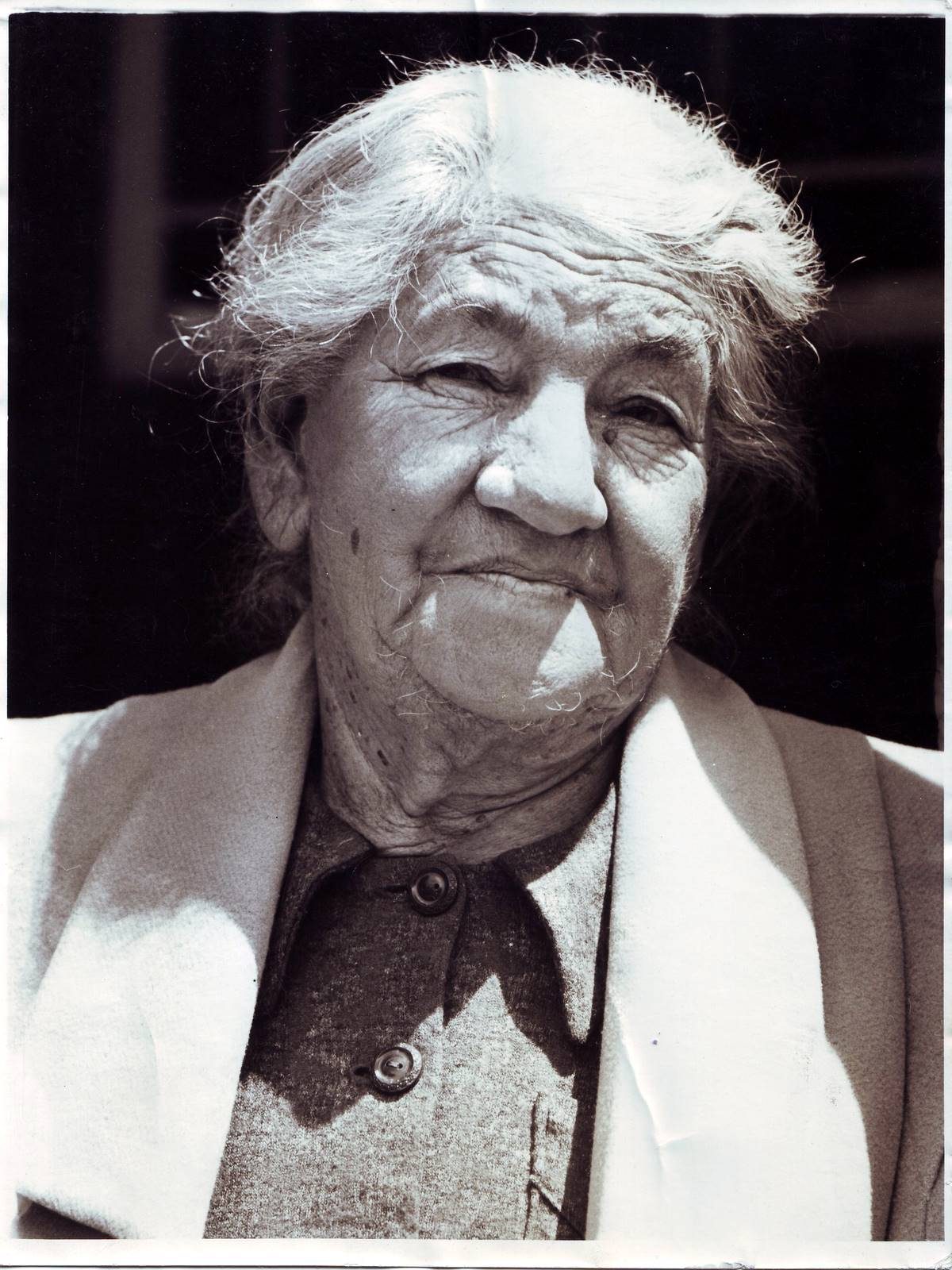
Then 1900 took two of her brothers, five weeks apart. Her father died on 3 January 1901. In May 1903 she married Almero Jacobus Hitge Oosthuizen and came to the Koup, and she is Frans's great-grandmother. The photograph of her in old age, white-haired in strong sun, is eighty years past the evening her brothers sat writing.
What these papers are, and are not
They are letters kept by the people they were written to, and passed down. Everything quoted here is transcribed from the leaves themselves, and the full transcriptions stand at SRC-444, SRC-445 and SRC-446.
Two things are not settled. The newspaper cutting carries no masthead and no date, so which paper printed Malherbes in Vryheidstryd, and when, is unknown. not yet verified And the testimonial names only Miss Johanna Malherbe, so the identification rests on the family having kept it with everything else. [FAMILY]
This is also a page about people who were not in the Koup. The four brothers were Transvalers by the time the war reached them, and their war is not this district's war. It is here because their sister came here, and because two men writing home on the same evening, in the same town, to the same sister, is the kind of thing a family keeps for a hundred and twenty-seven years and then hands over in a folder.
What this story is about
- about Johannes Barnard Malherbe
- about Isaak Johannes Malherbe
- about Petrus Jacobus Malherbe (b.1871)
- about Johanna Fredricka Malherbe
Sources
Everything this story rests on, with a link to the original wherever one exists. Where a citation is incomplete it says so, an incomplete citation is a research gap, not a formatting problem. If your work is here and the credit is wrong or thin, please tell us and it will be fixed.
- Letter of Johannes Barnard "Jan" Malherbe, Pretoria, 5 October 1899, to his sister, the night before he left for the front Family papers, held by Frans OosthuizenTyped transcript on one leaf, headed "Pta. 5.10.99", opening "My dear Sus Mimm" and signed "Jan". A later hand has added a note in blue ink at the foot.
- Letter of Isaak Johannes "Izak" Malherbe, Pretoria, 5 October 1899, to his sister Minnie Family papers, held by Frans OosthuizenTyped transcript on one leaf, headed "Pretoria. 5/10/99", opening "My dear Minni" and signed "Izak". Pencil corrections in a later hand give "Mimmi", "Issie's", "Annie" and "others".
- Letter of Petrus Jacobus "Pieter" Malherbe, Plumstead, 2 January 1937, on the battle of Spioenkop Family papers, held by Frans OosthuizenTyped, two leaves, headed "Ashbury Rd., Plumstead. 2 Jan. 1937.", opening "My dear Bettie" and signed "Pieter". A manuscript line at the head reads "Moenie skrik vir die lang brief nie !!!"
- "Malherbes in Vryheidstryd", by dr. W. A. Malherbe Newspaper clipping, family papers, held by Frans OosthuizenUndated cutting, one column and a captioned photograph. The author names himself as the youngest son of Izak Malherbe. Publication and date NOT ESTABLISHED. [TO VERIFY]
- Testimonial for Miss Johanna Malherbe from the Principal of the Huguenot Seminary, Wellington, March 1896 Family papers, held by Frans OosthuizenOne typed leaf, signed in ink "A. P. Ferguson", dated Wellington, March 1896.
Photographs
Research notes
[16 Aug 2026] Written the day the letters arrived - "transcribe these fully and lets have a story about the letters". The transcriptions are recorded in full on SRC-444, SRC-445 and SRC-446 rather than only in the prose, so the story can be rewritten without the evidence moving.
THE PAGE IS MOSTLY QUOTATION ON PURPOSE. Two men making provision for their own deaths in the ordinary voice of a household letter needs no help, and STORY-VOICE.md would refuse any it was given.
SCOPE, STATED ON THE PAGE ITSELF: these are Transvaal brothers and their war is not this district's. The page is here because their sister married into the Koup, and it says so in its last paragraph rather than letting a reader assume the Malherbes fought from here.
OPEN: the newspaper cutting SRC-447 has no masthead and no date [TO VERIFY], and the 1896 testimonial names only "Miss Johanna Malherbe" [FAMILY].
kind is "anecdote" rather than a new "family": the enum check refuses a value that appears once, and a lone new kind is the shape of a typo. This is a family narrative built on documents, which is what anecdote already carries here.
The file was first written S040-, which is the prefix STO-0040 already uses. Renamed to S041- to match its own id; two stories under one prefix is the sort of thing that only bites months later.
[16 Aug 2026] VOICE PASS, v1.0 -> v2.0, both languages, and it was owed: the story-voice skill was NOT run when the page was written, and the check put this file at the top of the drift list - 1 narration, 3 bold-sentence, 2 punchline-ending in each language, worse than any other story on the site.
TEN EM DASHES BETWEEN CLAUSES, in a file whose benchmark S035 has none. That is the fault AI-TELLTALES.md was generated for and it came straight back the moment the skill was skipped. All ten gone; the dashes inside the quoted letters are now hyphens, which is what a typewriter puts there anyway.
Bold 9 -> 1 in the English and 2 in the Afrikaans, kept only for "die korporaalskap van Izak Malherbe" and the Huguenot Seminary. Two bolded whole sentences about the deaths were removed: the dates carry themselves.
"the reason this project holds the papers" -> "why the papers came south".
Counts now 0/0/1 in the English and 0/0/0 in the Afrikaans. The one punchline left is "He died eighteen months later", which is a fact and the end of that man's section.
NO FACT, HEDGE, QUOTATION, CITATION OR [TO VERIFY] CHANGED.
verify_af failed once, on "probably" inside a quotation that must not be translated; fixed by giving the Afrikaans reader the hedge in Afrikaans and keeping the quote - "Waarskynlik sy seun, skryf Pieter: probably his son." Passing 1/1.
[27 Aug 2026] AFRIKAANS LANGUAGE PASS, v2.1: long sentences broken, tone particles and the gedagtestreep out of our own prose. NOT a content change; verify_af confirms every fact of the English twin survives and the English is untouched.
[27 Aug 2026] RESEARCH SWEEP, v2.2: the cutting the whole second half rests on is now tagged (SRC-447).
v+ 28 Aug 2026: title and subtitle set. Written as 'Malherbe-broers' with the compound hyphen and 'hulle' rather than 'hul'. Checked: Jan fell 24 Jan 1900 and Izak 27 Feb 1900, thirty-four days, so 'vyf weke later' holds.
The research behind this page, kept separate from it: dated working notes, open questions, and what is not yet settled.