Kaart se keersy, 3198 (verso), Maart 1913
Kaart se keersy, Maart 1913
11559002 bloem annex 2.jpg.Die rekord
- Soort
- Kaart se keersy
- Kaartnommer
- 3198 (verso)
- Opgemeet
- Maart 1913
- Getitel
- 1957
- Argieflêernaam
- 11559002 bloem annex 2.jpg
Sitasie
- Titel
- SG Dgm 3198 of 1913 - the farm Bloemendal Annex No. 164, Prince Albert, with its deduction verso
- Bewaarplek
- Surveyor-General, Cape Town
- Verwysing
- SG Dgm 3198 (1010 struck), 191[3]; Sheet BL-1
- Soort
- SG diagram
- Afgehaal
- 2026-08-02
Die grond waaroor dit gaan
Navorsingsnotas
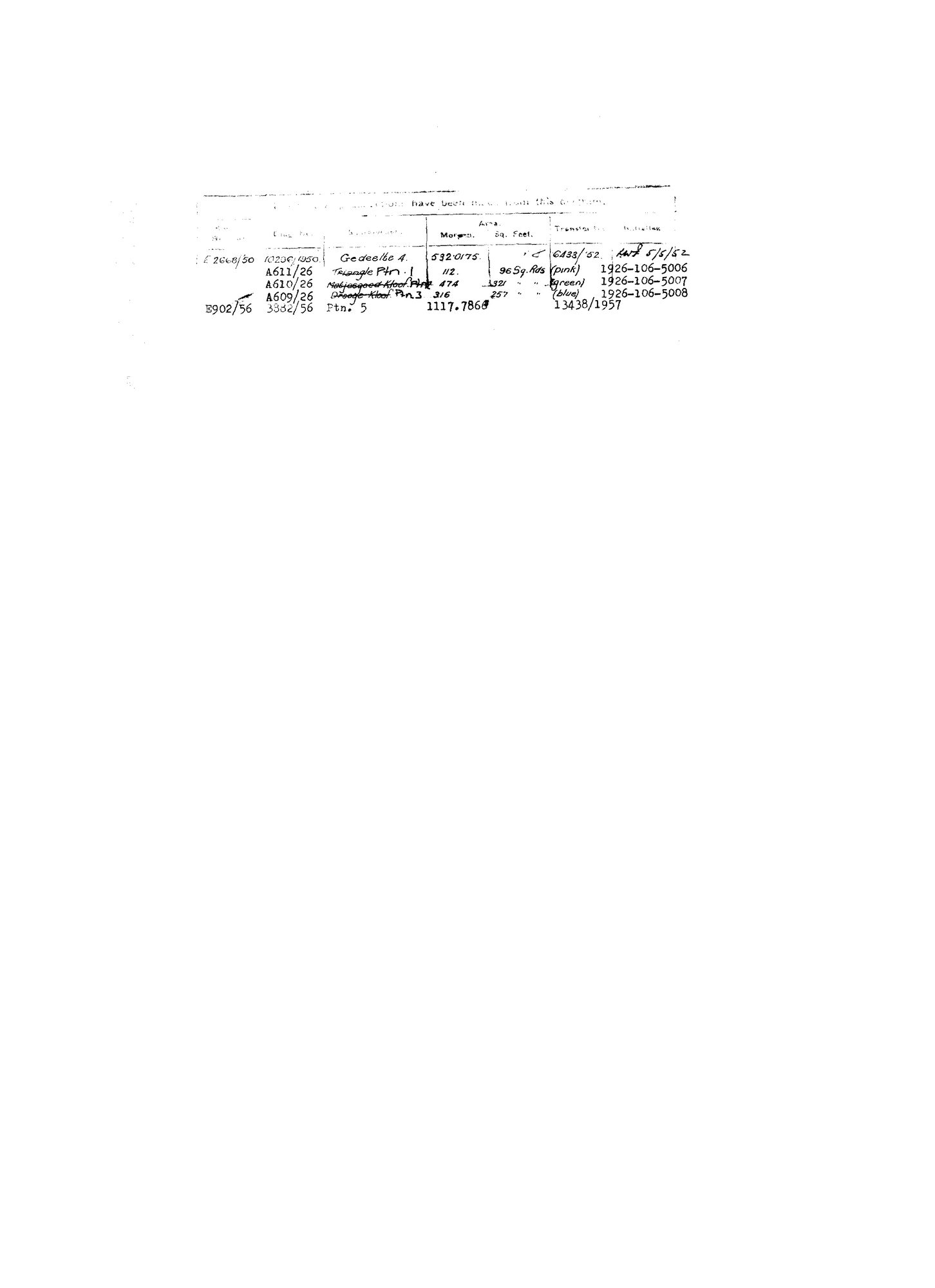
THE DEDUCTION TABLE, and the reason this sheet matters beyond its own farm. Five portions taken off Bloemendal Annex No. 164: Gedeelte 4 (dgm 10230/1950, 532.0175 mg, transfer 6433/'52); Triangle Ptn 1 (A611/26, 112 mg 96 sq rds, pink, 1926-106-5006); Ptn 2 (A610/26, 474 mg 1321, green, 1926-106-5007) with a struck-through name now known to read MATJESGOED KLOOF (corrected from 'Nabijgoed' against DOC-0166, the 2003 Farm 221 diagram, which still carries it as an official portion name); and Ptn 3 (A609/26, 316 mg 257, blue, 1926-106-5008) WITH A STRUCK-THROUGH NAME READING 'DROEGE KLOOF'; then Ptn 5 (3382/56, 1117.7868 mg, 13438/1957). *** SO A 'DROEGE KLOOF' EXISTED AS PORTION 3 OF FARM 164 AND WAS RENAMED. *** That is a SECOND Drooge Kloof - the first is the Government ground annexed into Middelwater by the 1833 diagram (DOC-0038). Neither is a current cadastral farm name: the Prince Albert division holds no farm called Drooge Kloof at all. See LEAD-0064.
[5 Aug 2026, verso-date sweep] §8: this verso carries endorsements LATER than its front, so it takes its own content dates instead of inheriting. The newest lines are Portion 5, diagram 3382/56 and deed 13438/1957. Inherited 1925 from front 3198 and published; now reads 1957 and is withheld.
[5 Aug 2026] publish_ok=yes. THE SHEET WAS OPENED AND READ, AND IT NAMES NOBODY. Five lines: Gedeelte 4, Triangle Portion 1, Matjesgoed Kloof Portion 2, Droege Kloof Portion 3 and Portion 5, with the 1926 transfer numbers and deed 13438/1957. That is the whole of it: portion numbers, portion NAMES, extents in morgen and square roods, diagram numbers, survey-record numbers, deed numbers and dates. Not one person appears on it. The 1936 scan cut-off exists because a JPEG is opaque to every text check in leak_tests.py, so a document's DATE is the only proxy available for whether the sheet names a living person. On a deduction table that proxy measures the wrong thing: the table is a record of GROUND, and withholding it withholds the farm's own history to protect nobody. Same decision, same reason and same mechanism as DOC-0081 on 3 Aug, when [FAMILY] I was talking about the old farm diagrams only. The date fields stay as they are, because the row has to state what is on the paper and the earlier inheritance from the front was simply wrong. What changes is that the release is now a decision somebody took after looking at the sheet, which is the only thing publish_ok has ever been for.
[5 Aug 2026] survey_edtf CORRECTED to '1913-03', from '1956'. It had the year of the SURVEY RECORD CITED IN THE DEDUCTION LINE, which is a date the table refers to, not a date this sheet was made. A verso is physically the same piece of paper as its front and was surveyed when the front was (DOC-0160, 3198 (1010 struck)); the later endorsement belongs in title_edtf, which carries it. _doc_year() takes the max either way, so the gate reads the same year as before and nothing about what publishes changed. The publish_ok escape is bounded independently in leak_tests to SG diagrams whose own survey predates 1942, so this row's survey_edtf has to be the FRONT's survey year for the sheet to be released at all.
Die navorsing agter hierdie bladsy, apart gehou daarvan: gedateerde werksnotas, oop vrae, en wat nog nie uitgemaak is nie.
Die werksnotas op hierdie werf word in Engels gehou en word nie vertaal nie. Hulle verander met elke navorsingsessie, en 'n vertaling sou uit pas raak met die oorspronklike. Alles anders - die stories, die getranskribeerde dokumente en die koppelvlak - is in Afrikaans.